The Evolution of Esports: From Niche Hobby to Global Phenomenon


The Evolution of Esports: From Niche Hobby to Global Phenomenon
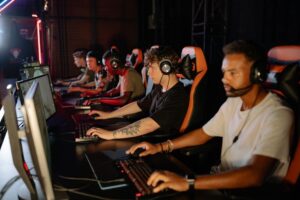
The image of a packed stadium, roaring with thousands of fans fixated on a massive screen displaying a virtual battle, was once a sci-fi fantasy. Today, it is the reality of esports—a multi-billion-dollar industry that has transformed from basement LAN parties into a cultural and economic juggernaut. Tracing this evolution reveals a story of technological progression, community resilience, and shifting societal perceptions.
Chapter 1: The Arcade and Dorm Room Roots (1970s–1990s)
Competitive gaming’s genesis lies in the arcades of the 1970s. While Spacewar! (1962) hosted informal contests, the first recognized esports event was the 1972 Spacewar tournament at Stanford University. The prize? A one-year subscription to Rolling Stone magazine. However, the true catalyst arrived in 1980 with Atari’s Space Invaders Championship, attracting over 10,000 participants—the first mass-scale video game competition.
The 1990s shifted the playing field from coin-operated cabinets to personal computers. The release of Street Fighter II (1991) spawned a fighting game community (FGC) that gathered around arcade cabinets and, later, home consoles. Simultaneously, the rise of first-person shooters like Doom and Quake created the framework for networked multiplayer. The term “esports” itself is often credited to the late 1990s, co-opted from the phrase “electronic sports” by organizers seeking legitimacy. Major events like the Cyberathlete Professional League (CPL, founded 1997) and the QuakeCon tournaments formalized competition, using rental servers and dial-up connections—a far cry from today’s cloud infrastructure. Prizes were modest, often hardware or small cash sums, and players competed for glory, not a living wage.
Chapter 2: The Broadband Boom and StarCraft’s Blueprint (2000–2010)
The turn of the millennium brought broadband internet, revolutionizing accessibility. In South Korea, a perfect storm of economic factors, government investment in high-speed networks, and the release of StarCraft: Brood War birthed a national obsession. PC bangs (internet cafes) became crucibles for talent. The Korean e-Sports Association (KeSPA) was established in 2000, creating the first regulatory body for competitive gaming. Televised matches on channels like Ongamenet (OGN) turned professional gamers into celebrities. This Korean model—with franchised teams, rigorous training regimens, and dedicated management—became the blueprint for global esports.
During this decade, Western esports found its footing. The launch of Counter-Strike 1.6 and Warcraft III (which birthed Defense of the Ancients, or DotA) provided staple titles. Major League Gaming (MLG) emerged in the US, pioneering live event production for console titles like Halo and Super Smash Bros. Melee. The prize pools grew but remained modest; the 2004 CPL World Tour awarded $150,000—a fortune at the time. Despite growth, esports remained a subculture, often dismissed by mainstream media as a frivolous pastime.
Chapter 3: Streaming, Fandom, and The League of Legends Revolution (2011–2017)
The release of League of Legends (LoL) in 2009 by Riot Games marked a paradigm shift. Unlike previous developers, Riot actively invested in competitive infrastructure. The 2011 Season 1 Championship had a $100,000 prize pool; by 2013, the Season 3 World Championship pool reached $2 million. Riot implemented a structured regional league system (LCS, LEC, LCK), mirroring traditional sports. This forced synergy between developer and organizer created stability previously unseen.
Concurrently, Twitch (launched 2011) democratized viewership. No longer reliant on cable TV, esports found a direct line to global audiences. Streaming turned amateur players into celebrities and allowed fans to engage deeply with personalities. The viewership explosion was staggering: the 2014 League of Legends World Championship had 27 million unique viewers, surpassing the NBA Finals. Games like Dota 2, with its crowd-funded “Compendium,” shattered prize pool records, culminating in the 2017 International’s $24.7 million pool. This era also saw the rise of Counter-Strike: Global Offensive (CS:GO), which revived a fractured PC shooter scene with publisher-backed Major tournaments.
Chapter 4: Institutional Legitimacy and Media Rights (2018–2021)
The late 2010s marked esports’ arrival in the mainstream. Traditional sports organizations—the Kraft Sports Group (Boston Uprising in the Overwatch League), the Philadelphia 76ers (Dignitas), and the New York Yankees—purchased teams, injecting corporate capital and business rigor.
The Overwatch League (OWL), launched by Activision Blizzard in 2018, attempted to replicate the city-based franchise model of American sports. Despite a rocky start and inflated franchise fees (estimated $20 million per slot), OWL secured landmark broadcast deals with ESPN, Disney, and ABC. This signaled a critical shift: media giants no longer viewed esports as niche. The 2018 League of Legends World Championship final, held in a packed Incheon Munhak Stadium in South Korea, was broadcast in 19 languages across 40+ platforms. China emerged as the industry’s superpower, with Tencent (parent of Riot Games) centralizing control. The viewership numbers became staggering: the 2019 League of Legends Worlds reached a peak concurrent viewership of 44 million.
The COVID-19 pandemic in 2020 paradoxically accelerated esports’ legitimacy. As traditional sports paused, esports were uniquely positioned to continue virtually. Simulations like NBA 2K League and virtual F1 filled the sports void, introducing new audiences to competitive gaming. Mobile esports, particularly PUBG Mobile and Free Fire, exploded in Southeast Asia and Latin America, reaching demographics previously untouched by PC gaming. Prize pools for these mobile titles rivaled their PC counterparts, with the 2021 Free Fire World Series granting $2 million.
Chapter 5: Commercialization, Fractures, and The Modern Era (2022–Present)
The current era is defined by maturation and recalibration. The frothy venture capital investments of the late 2010s have cooled, forcing teams and leagues toward sustainable business models. The Overwatch League’s end in 2023, replaced by the open-ecosystem Esports World Cup (EWC) in Riyadh, Saudi Arabia, represents a shift from city-based franchises back to meritocratic, tournament-driven competition. The EWC, with a record-breaking $60 million prize pool, has drawn both praise for its scale and criticism over sportswashing allegations.
Game publishers now wield immense control. Riot Games’ Valorant Champions Tour (VCT) has created a streamlined global circuit, while Epic Games’ Fortnite turned in-game cosmetic sales into a $100 million+ prize pool ecosystem. However, the model is not without friction. Esports organizations like FaZe Clan, 100 Thieves, and TSM have faced layoffs and restructuring, reflecting the harsh realities of a market correcting from overexpansion. Player welfare has become a central issue; unions like the National Esports Association (NEA) and individual player associations negotiate for better contracts, minimum salaries, and healthcare—a stark contrast to the pizza-fueled LAN parties of the 1990s.
The viewership landscape has diversified. Twitch remains dominant, but YouTube, TikTok live, and regional platforms (e.g., AfreecaTV in Korea, Douyin in China) fragment the audience. The rise of data analytics (e.g., Oracle DB for League of Legends) and AI-powered coaching tools have professionalized training, while augmented reality (AR) overlays during broadcasts have improved the spectating experience. The 2024 Esports World Cup showcased hyper-realistic AR player statistics and 3D replay systems, blurring the line between virtual and physical sports.
Chapter 6: Technology, Infrastructure, and The Next Frontier
The infrastructure behind esports has evolved parallel to its commercial growth. Low-latency edge computing and 5G networks reduce input lag, enabling real-time competition from disparate continents. Cloud gaming services (GeForce Now, Xbox Cloud Gaming) lower entry barriers, allowing competition on low-end devices. Blockchain and NFTs, once hyped as ownership tools for digital assets, have seen limited adoption due to volatility and fan pushback, though some teams use them for ticketing rewards.
Educational integration has surged. Over 200 North American universities now offer esports scholarships, and institutions like the University of California, Irvine (UCI) have purpose-built esports arenas. High schools form clubs and varsity teams, treating esports with similar rigor to football or basketball. This has created a pipeline for talent but also raised concerns about screen time and injury management—issues addressed by dedicated sports medicine programs.
Game design itself increasingly accounts for competitive integrity. Games like Valorant and Overwatch 2 are built with spectator modes, spectator-friendly HUDs, and anti-cheat systems (e.g., Riot’s Vanguard) baked into their core architecture. This represents a sea change from early esports, where broadcast tools were afterthoughts. Machine learning algorithms now analyze millions of matches to identify emerging strategies, while AI-powered automated camera systems in arenas reduce production costs.
The internationalization of esports has brought unique regulatory challenges. Visa issues for players remain a persistent hurdle; the 2022 Dota 2 International faced multiple roster disruptions due to travel restrictions. Countries like China strictly regulate game content and streaming hours for minors, impacting the talent pipeline. The lack of a unified global governing body means disputes are adjudicated by game publishers, creating monopolistic control over the competitive landscape.
Gender diversity, or the lack thereof, remains a glaring issue. While cash-prize parity exists in many open tournaments, the representation of women and non-binary players in top-tier competition is below 5%. Grassroots initiatives like the Women in Games International (WIGI) and female-only tournaments (e.g., GirlGamer Game Festival) aim to foster inclusivity, but structural barriers persist.
As esports enters its fifth decade of organized competition, its transformation from a niche hobby to a global phenomenon underscores a fundamental shift in how humanity plays, watches, and values competitive achievement. The industry now supports a global ecosystem of talent scouts, performance coaches, broadcast engineers, and data scientists. From the static-filled monitors of 1972 to the high-fidelity, multi-million-dollar productions of today, the evolution of esports reflects the broader trajectory of digital culture itself—relentlessly innovative, deeply competitive, and increasingly inseparable from mainstream life.